



A provocative title, but let’s be honest. Literally none of the advice people gave me when I was younger moves the needle at all in this current age. The exception, of course, is having talent, connections, and being in the right place at the right time. Everything else? A complete waste of time.
There is a classic origin story that anybody and everybody who has made it in the entertainment industry will tell you. It’s the same story I will tell you now.
When I made my decision to get serious about writing screenplays, I came into contact with veterans of the industry. People who had made it. They had sold scripts, gotten movies made, and lived to tell the tale. Without fail, they would ask me the same question.
“Is it money you want?” They would ask.
“Well, money would be nice, but—”
“Because if it’s money you want, there are about fifty million other things you can do that are easier to make money.”
“No,” I pleaded. “This is what I want to do.”
“Because,” they said without hearing my answer. “This is a despicable business. Honest to God, it’s bad. And by the time you realize it for yourself, it will be too late, so I ask you again. What do you want?”
The truth is, I wanted all the things he described. I wanted to make millions. Have an enormous house in the Hollywood Hills. I wanted famous friends, to be a household name, and leave a legacy that would live on long after I was dead.
Now, thirty years later, I am the one asking young writers the same question. I have a deeper understanding of its meaning, and the breadth of my experience informs my perspective.
I used to think asking these questions was about thinning the herd, and I still believe that to an extent, but it turns out attrition is a self-cleaning oven. You might worry you need to derail young talent to keep yourself from becoming irrelevant. You don’t. Believe me when I tell you they will derail themselves with no help from you.
So many writers I have mentored struggled with the one key element you simply can’t teach. The unquenchable desire to write.

These people, nice as they may be, will never achieve the success they think they want. Why? Because it’s incredibly difficult to master. It’s the work of a lifetime, and if you can’t find the desire to start, you will never have the stomach to finish.
I’m sorry. I said it. Without that desire, you will never get the notes and constructive criticism you need to get better. Nor will you grow the tough, thick skin needed to listen to people tell you no. You’ll miss the very important stage where you realize and accept that the stuff you wrote early on is complete and utter shite.
But I digress…
To master any craft takes focus and tremendous drive. You don’t just want to do it, you need to do it. It’s not a chore for you, even when it’s hard. Stopping is out of the question. This drive is a crucial part of every success story, but it’s not the only thing.
It has to be paired with a tireless need to get better. It’s a place where you’re never satisfied with where you are. You can feel a sense of accomplishment and make a note of how far you’ve come, but you will always look for and soak up any new pieces of wisdom along the way.
So, let’s assume you’ve checked all the above boxes. You’re ready to take the town by storm. Let’s see if the old advice holds up.
1. I was told you needed to live in Los Angeles and drive a nice car.

This advice doesn’t hold up. The theory about the car was if an agent or producer saw you pull up in a beater car, they’d assume you’re a fraud. Just a nobody who’s clearly never had a measure of success before.
It’s sad to think that you hopping out a black Land Rover really made that much of a difference, but it did back then. You needed to look as if you already had the thing you were hoping for and didn’t really care if you got it or not.
Nowadays, none of that is true. Why? When was the last time anybody went to a meeting in person? Everything is a Zoom meeting or a FaceTime call. You simply never show up in person. Your reality is virtual. Your Zoom background image can turn you into anything you want to be.
Similarly, your location is less important. As long as you have a computer and an internet connection, you can plant your flag wherever you want.
2. I was told you needed a fresh perspective. You needed to be good, but also original and like nothing anyone’s ever seen.
Okay, for the record, I thought this was bullshit then, and it’s definitely bullshit now. Nobody wants to take a chance on anything in Hollywood, let alone you. Originality scares the shit out of Hollywood. Films are giant rocks that a large team of people reluctantly push up a hill, usually for years. If you show up with a shiny new rock they’ve never seen before, they simply smile and send you out to the front desk to get your parking validated.
Why? Why are they so scared? I’ll tell you. A smart person once told me that if a producer says no 100% of the time, they are right 99% of the time. Think about that. Let that sink in.
That translates into pre-existing properties, sequels, franchises, and anything that is a known quantity. The safer, the better. Despite what you might have heard, it’s not a dream factory. It’s a business. It’s about market share, stockholders, and profit-and-loss statements.
3. You need to be networking and meeting people constantly.
What? In person? Networking in Hollywood is only as successful as you are useful to people. I understand the idea that if you are being seen; you are being talked about, and if you are being talked about, you are part of the conversation. While this, on its face, isn’t bad advice, smart people are doing this without leaving their house. Social media has become the meeting place for the world. Making yourself a part of the conversation happens because you are the one leading it. Why? Because you have a sizable social media presence, and they engage with you. Showing up for drinks at the latest hotspot is both a waste of time and money. If people see you are making waves in the social media universe, they will be more willing to pay attention.
4. I was told countless times that I should focus on either film or TV projects. You can’t go back and forth. You will get pigeonholed, and you can never get out from under it.
Oh, to be pigeonholed. The world of streaming has changed the entire landscape. Jobs are so scarce that talented writers may specialize in a specific medium, but they know they have to be flexible.
The rise of big mega blockbusters and multiverse superhero projects is miles away from what passed as a blockbuster in the seventies, like Jaws or Star Wars.
The slow death march that killed what we used to know as independent cinema simply re-emerged as the long-form serialized TV series on every streaming service in existence. It just takes a quick peek at the creators, writers, and directors of these shows to discover most of the legends of indie film are working in TV.
5. How about this one? If your script is good, it will rise to the top of the heap.

Maybe. But I’m also kinda calling bullshit here. Why? Because the competition is fierce. Despite hearing how bad scripts are out there and how nobody is writing anything new, the truth is, they are. And a lot of those scripts are fantastic, but no one is going to make a fantastic script about Jim Henson dropping acid and conjuring the Muppets during a lengthy road trip to Burning Man.
Yes, write great scripts. Of course. Just understand that it may end up in a pile alongside other fantastic scripts. And if the subject matter is difficult or too niche, it will make a beautiful doorstop before it ever makes a movie.
I can hear what you’re thinking. Frank, I’m only going to write what I am passionate about. Why should I change? Why should I dumb it down for the masses?
Why, indeed? The short answer is you don’t have to. If you want to write the kind of material that has a limited audience but is fantastic and compelling. More power to you. I think that’s great. I take no issue with what people choose to write about.
This article, however, isn’t about what makes up a good story. It’s about breaking into Hollywood, which many would argue is a place that does not exist anymore.
The main point here is that somewhere along the line, art must meet commerce. It’s the entertainment business. You are here to entertain. You want to change the world? You have to find ways to make the medicine go down.
This all seems so dour and depressing. What does all of this mean? What advice do you actually give people in this day and age if they want to be a successful writer in Hollywood?
That’s easy. You might not like it, but I’ll be happy to tell you. There’s no gatekeeping here. I’ll hold the door for you. Honest.
This goes back to the original question. What is it that you actually want?
Success? Fame? Money? A big house? All the above?
If those are your primary answers, then I would probably recommend another profession. Why? Because if “Creating something” isn’t the number one item on your list, you might as well be a paper pusher.
Now, if you want to create something from nothing and engage the part of your brain, that sees that anything is possible, then you’re speaking my language.
Here’s some advice.
1. Use any form of new media you can.
Currently, in 2026, the tools available to you as a creative person are endless. There has never been a time when access to the public has been easier. Social media sites offer platforms where you can mainline your creative projects directly to your own audience. Cameras on smartphones are good enough now to shoot short films on.
And for all the talk of AI stealing jobs from people in the entertainment industry. Yes, that is a valid concern. As a working writer in the industry, my imagination overshadows my fear of it. I see these AI apps as tools to help me be better at my job. And it does make me better. We can’t bury our heads in the sand and tell people we won’t accept it. It’s already here. There is no putting the genie back into the bottle.
And no, in case you’re wondering, I don’t worry about AI writing a better story than me. Here’s why. You know who else can write a better story than me? Thousands upon thousands of real people who have their own unique perspectives. That didn’t stop me before, why should it now?
By the time we stop using writers to create, we will have bigger problems on our hands. The reason this doesn’t bother me is that AI does not affect my core motivation in life, which is to create.
Money, fame, and success are simply side effects that come and go with the territory.
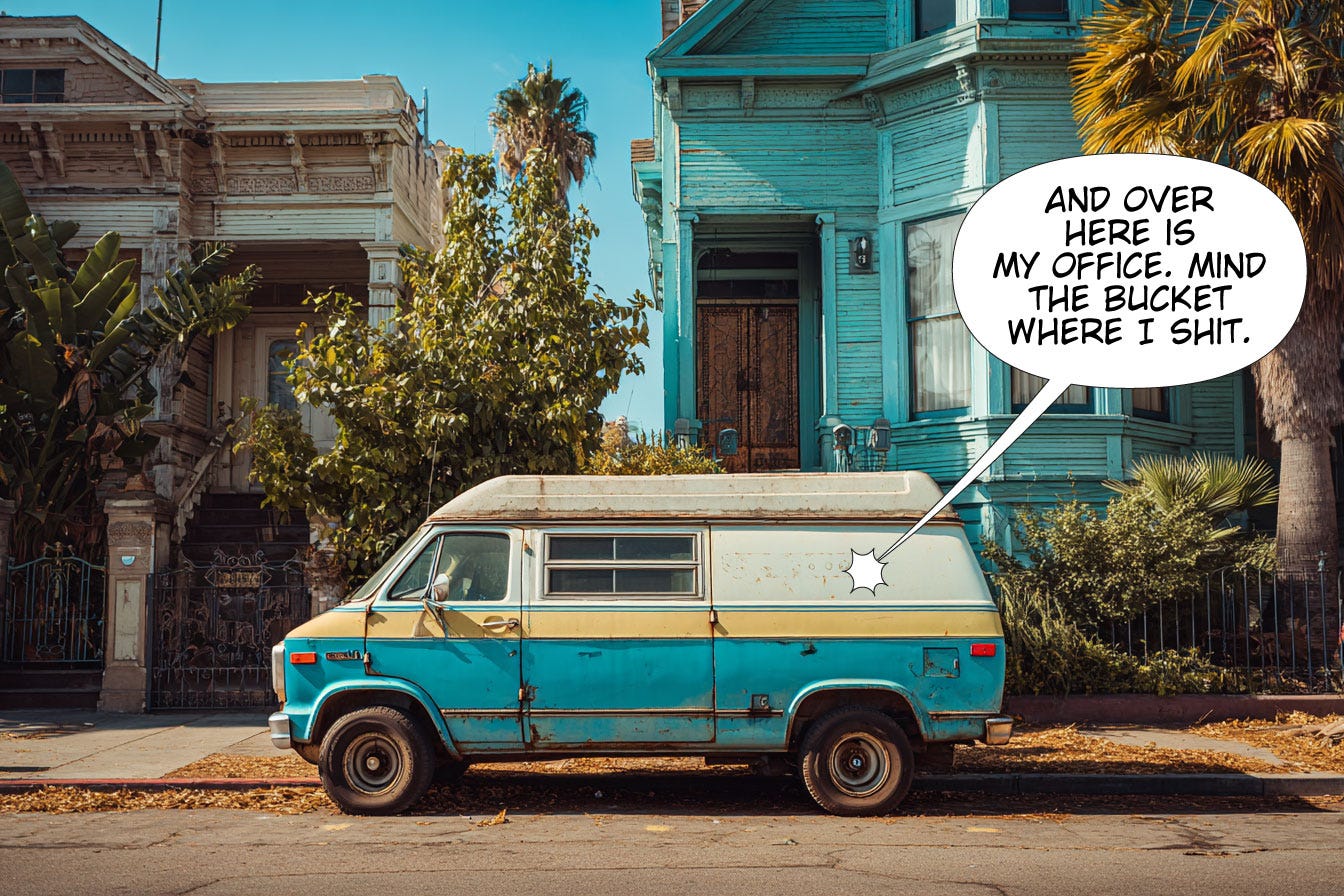
2. Keep a low overhead
.
This is my biggest secret. It’s one I stumbled on over the years because I gained a clear understanding of my priorities. Life is expensive. Even the basic, single-serving option you start out with as a young adult.
Sacrifices must be made to continue the luxury of living a purely creative life. Do you want a wife, a house, and a family? Okay, that’s fine. Do you want them now? If so, you can probably forget about living the dream.
Damn, Frank! That’s harsh! Not really. If you want kids, great. If you have kids, then you’d better make them your number one priority. If your screenplay baby is more important than your kids, then you’ve made a massive mistake.
Is it possible? Perhaps. Is it realistic? No.
Bottom line, to continue doing what you love, you need to be prepared to make sacrifices. It’s why I keep a very low overhead. What that looks like for you may be entirely different. That’s okay, there is no one-size-fits-all. I’m simply suggesting that understanding this upfront will make it easier to decide what is possible and what is not.
3. Understand that creating is a spectrum.
Let me explain. You must accept that your career, if there is one, will ebb and flow constantly. This means you will probably need to take on other jobs to make ends meet while you await your next big payday or residual check.
Take a moment to appreciate that being a writer means creating something. If this is indeed your passion, you stand to get a powerful hit of accomplishment from many other forms of creativity. This is the key. This will keep you from choosing a job that is complete drudgery and one that feeds your soul just enough to keep you in the game.
It’s a delicate balance, and knowing what those things are requires trying them. That’s how you find out.
I love expressing myself in various ways, and knowing there is a spectrum of choices at my disposal keeps me from going insane.
4. Be Prepared to Do it Yourself!
I spent a great deal of time waiting for people with power to tell me I was good enough or whether my ideas were worth pursuing. I quickly became tired of hearing the word no. Either my idea was too dark, too niche, too expensive, or too crazy.

It’s soul-crushing. I woke up one day and literally heard myself announce to no one in particular that I was just going to do it myself.
I was going to stop waiting for permission from others to pursue a project. Sometimes, that means learning how to do things outside your comfort zone. The tools are there, you just need to take advantage of them.
Will you fail? Of course you will. Will it be immensely satisfying? You bet it will. The trail of dead ideas and projects I have left behind me is long and storied, and I don’t regret a single one of them.
I don’t love to fail, but it doesn’t scare me. If I choose not to do something, failure is no longer the reason. Every failure has taught me something. Every misstep, bad decision, and bellyful of hubris that exploded in my face has strengthened me. It’s given me the courage to take on things I probably had no business starting.
Don’t wait for people to tell you yes. You have everything you need to say yes to yourself. Do that and then sit back and see what you come up with.
There! I’ve said too much, but I’m sure there were a few gems in there somewhere.