


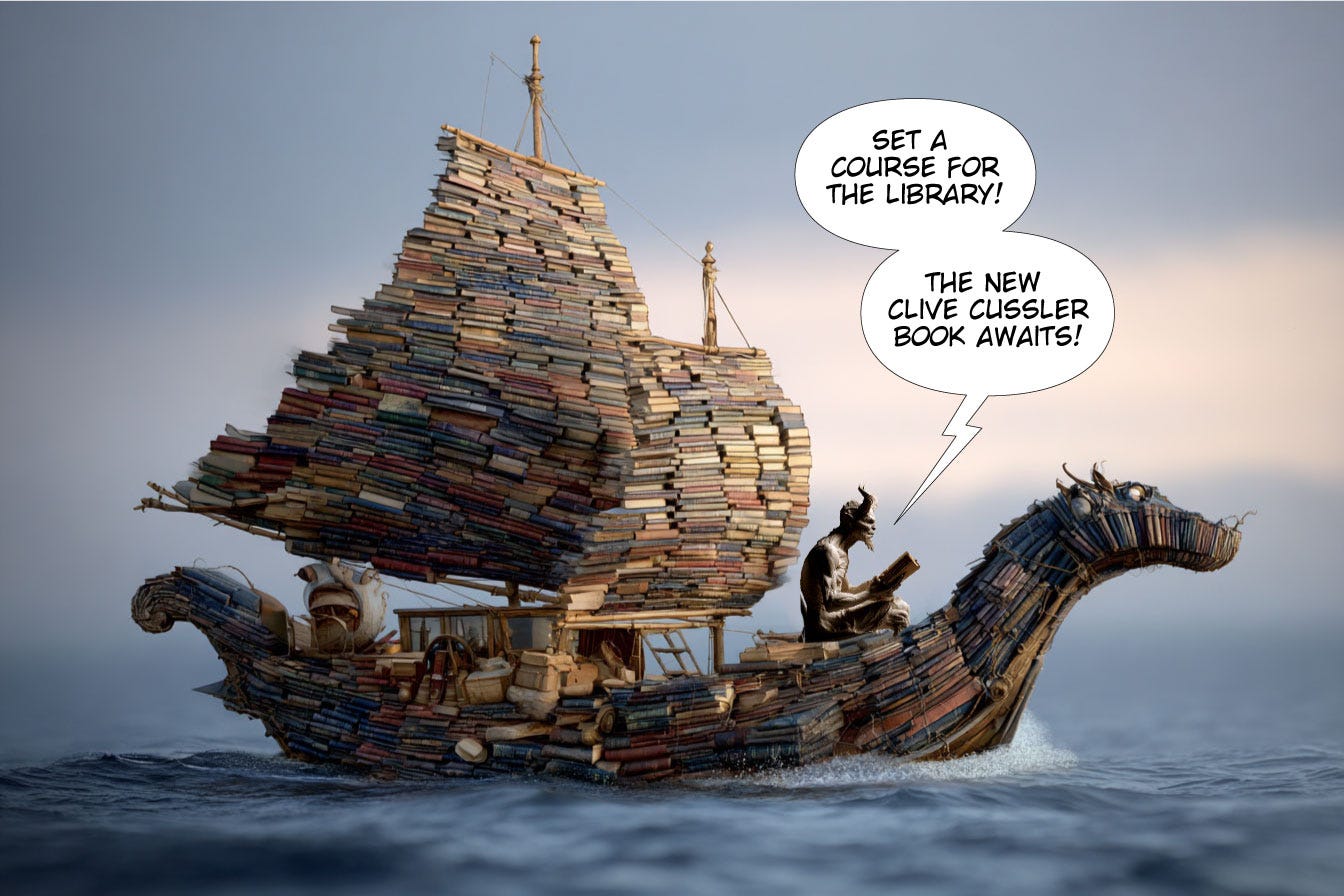
When I think about the thousands of books the old demon has read over the last eighty years of his life, I am staggered. Voracious is a fitting way to describe it. As a boy, trips to the local library were common. He would take out three or four books at a time and make more than one trip per week.
It’s similarly troubling to think of all the books he’s forgotten. I like to joke that he’s forgotten more books than I will ever read in my lifetime, and I don’t think that’s an exaggeration. His thirst for knowledge was always apparent, and I think I have to give him credit for instilling the same sense of curiosity in me that remains as strong today as ever.
While he read anything and everything he could get his hands on, like most “dads” of his generation, he liked books about submarines, boats, and military battles. He loved Sharpe novels by Bernard Cornwell about English soldier Richard Sharpe during the Napoleonic Wars, the Jack Aubrey novels by Patrick O’Brian that started off with Master and Commander, and he loved anything that took place on the sea.
This love of the sea took hold early in his life. My father spent his early years in the merchant navy as a shipwright. He traveled the world many times over, and it opened his eyes to a wider perspective. As a poor kid from Glasgow, he knew the opportunities at home were few and far between. His coming of age did not happen on land. It happened at sea, and upon his first return home a year later, he found himself unable to stand being around his old friends. They remained close-minded, bigoted, and bitter about their chances.
The life and person he was becoming no longer fit into that small worldview. I think his love of reading was the next best thing to real adventure.
He loved to tell my brother and me about the stories he was reading. I have a distinct memory of my father telling us about Annie Wilkes, the demon caretaker in Stephen King’s book Misery. I remember him acting out the scenes where Annie questions the character of writer Paul Sheldon about why he tried to escape and how calmly and menacingly she spoke as violence loomed in the background.
He always encouraged us to read, and he would take us with him on his library trips. Mostly, I picked out Peanuts Comic strip collections. I was young, after all.
I would love to say I followed in my father’s footsteps and read voraciously throughout my childhood, but I didn’t. For some reason, it just didn’t take.
Then, when I reached high school age, reading became compulsory. We were tasked with reading books for English class, among others. I didn’t consider this reading for fun.
Then, one day I went to see a movie called The Believers. It was a thriller about a recently widowed police psychologist who is investigating a series of ritualistic child murders in New York City.
It starred Martin Sheen in the lead role. It explored the dark world of Santeria. While the film was criticized for its portrayal of a mostly benign, yet primitive religion, the film absolutely captured my imagination. So much so that when I discovered the film was based on a book called The Religion by Nicholas Conde, I sought it out and devoured it quickly.
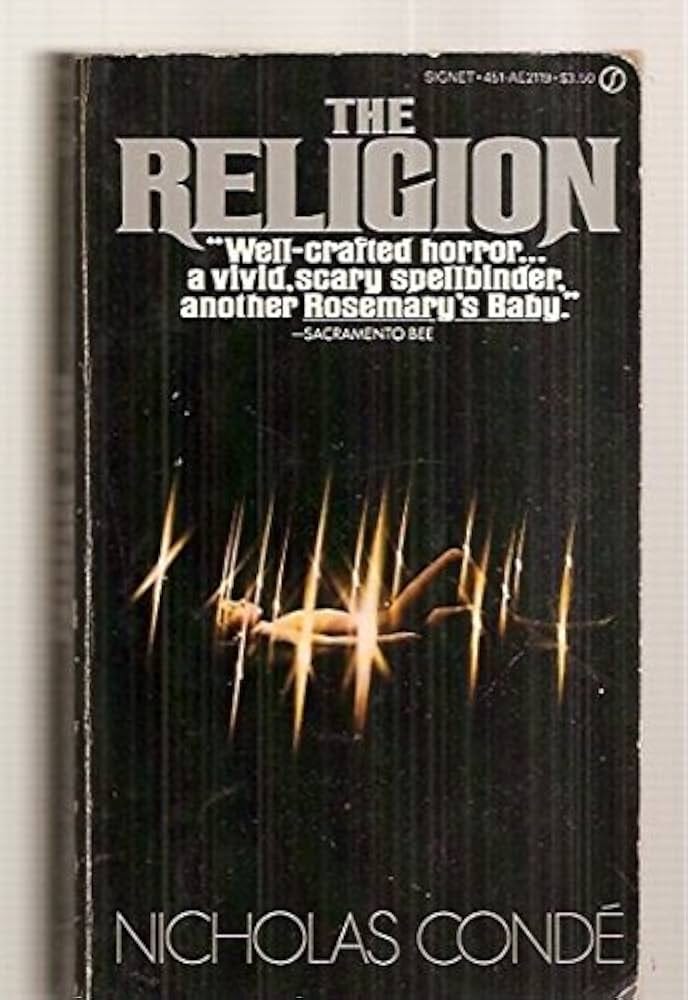
It was the first book I remember reading for pleasure, besides Charlie and the Chocolate Factory by Roald Dahl, which was in my early youth.
From there, I searched for other books that could give me that same jolt of excitement. I’ll be honest with you. Just finishing a book was an achievement. I would tell people I had finished a book, and they would say, “Yeah, I read that. It was a horrible book.”
All I could think of at the time was, “Well, yeah, but I finished it!”
It didn’t occur to me to have an opinion about them. There were a lot of touchstone-type books I read that really made an impression on me. As I read more and more, I built a library in my mind of the good and the bad, and the meh.
I started collecting books. Many more books than I would ever read. All from used bookstores that would cost a dollar a piece. It became a bit of an identity. If I have a lot of books, then people will think I am smart. Yeah, I know. Stupid.
One day, I was in a bookstore in the literature section, and a girl who worked there approached me, pulled a book off the shelf, and said, “Read this. It changed my life,” then simply walked away.
The book was Demian by Hermann Hesse. I had read none of his work before.
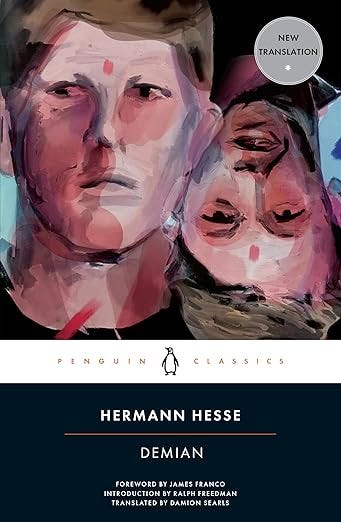
Demian was a coming-of-age novel that traced Emil Sinclair’s path from innocence to self-awareness. Raised in a protected world of clear right and wrong, Sinclair is gradually pulled into a more complicated reality through experiences with fear, doubt, and inner conflict.
Under the influence of an enigmatic stranger named Max Demian, he begins to question traditional ideas of morality and identity. As Sinclair struggles with both external pressures and his own internal contradictions, he learns that growth requires embracing the full spectrum of who he is — not just the acceptable, “good” parts, but also the darker, hidden sides.
Ultimately, the novel explores the difficult but transformative journey toward becoming a whole, self-defined individual.
Now, that description doesn’t exactly scream read me, but knowing nothing about the book, I read it, and it transformed me. I can’t explain it, but my best description is to say that it felt like a book about teenage angst. It was like a John Hughes movie without the silly comedy written in the early 20th century.
From there, I read all the Hermann Hesse books I could find. From Steppenwolf to Siddhartha, Narcissus and Goldmund, and Beneath the Wheel. All of them spoke to me in a way that other books did not.
As a side note, many years later, completely by chance, I saw the girl who suggested the book to me. I fell over myself to speak to her. She must have thought I was a crazy person.
“Excuse me. This is gonna sound weird, but like ten years ago, you suggested a book for me to read and you said it would change my life. I just want to tell you it did, and I tell everyone I meet about it.”
“What was the book?” She asked.
“Demian by Hermann Hesse.”
“Oh, yeah,” she said. “That’s a good one.”
To be honest, her response didn’t quite match my enthusiasm about it, and I felt a little embarrassed for gushing in the way that I did, but I know in my heart she felt a sense of satisfaction. It’s the same satisfaction I get when people I have told to read it have come back and gushed to me about it.
Thus, my journey into book knowledge continued. I cursed myself for not reading earlier, as my reading comprehension definitely suffered. Influenced by others, I read the works of Borges, Cortázar, and Gabriel García Márquez. One Hundred Years of Solitude was an enormous challenge for me to finish. While I set it down many, many times, the turning of the last page was so satisfying, I believe I might have welled up with tears.
For the old demon, reading was something so fundamental to his existence that he probably didn’t share the same epiphanies as I. Reading was a humbling experience. Like the ocean of my father’s early years.
I saw it as something vast and powerful, to be respected and learned from if only you are willing to step into the deep end.