


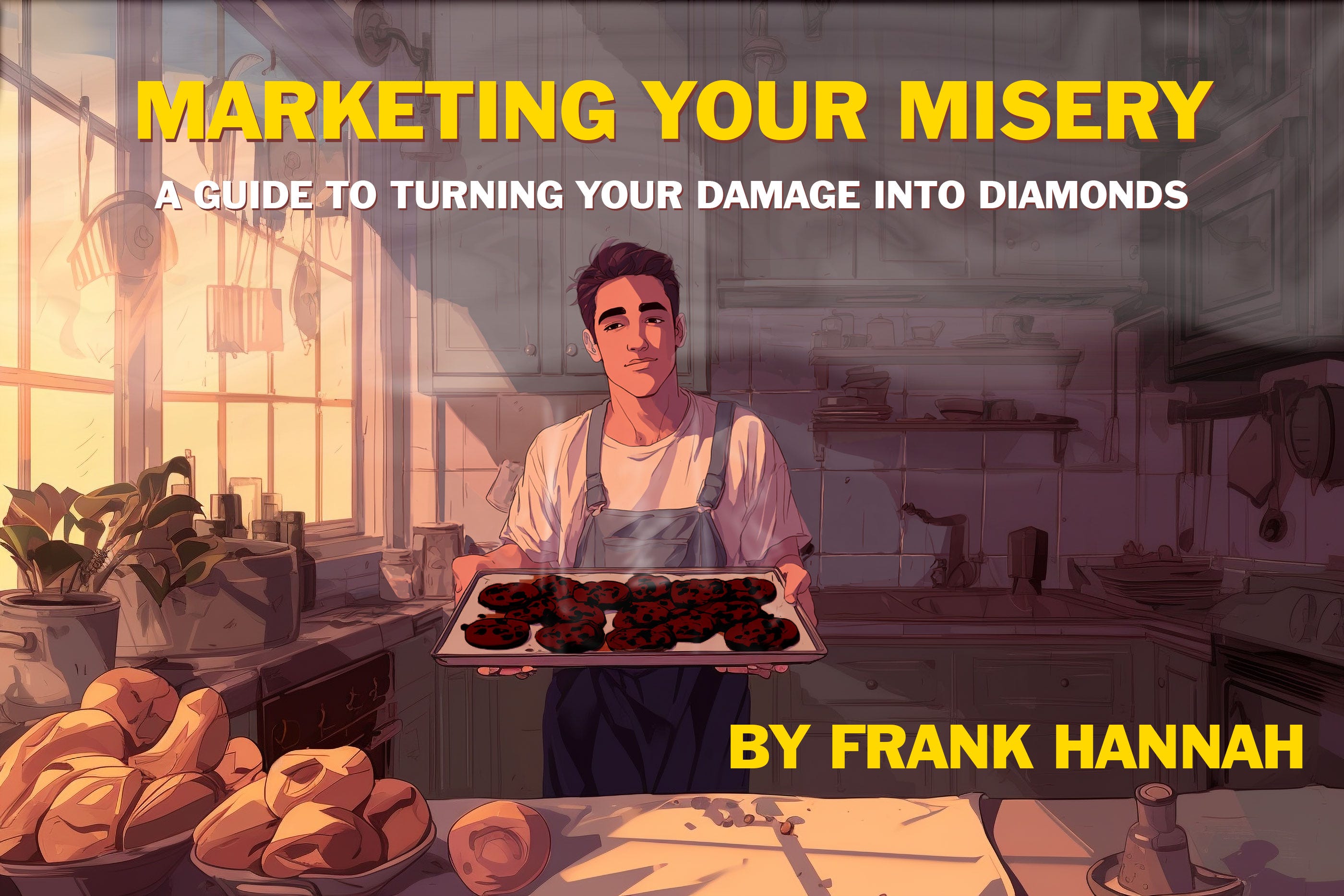
Introduction:
What the hell is this, and what is it all about?
My name is Frank Hannah. I’ve spent the last three decades telling people the following sentence. “If you have a special skill, it’s just a cry for help. You’re just marketing your misery.”
As many times as I’ve said it, many more have asked for an explanation. I usually respond with a basic anecdote or two. It went something like this.
Sometimes, acquiring special skills points to a need for attention. A “love me” kind of reaction to a sense of lack. It’s not an original observation. It’s why the entertainment industry is filled with extremely talented, yet completely dysfunctional people who are starved for attention. Not all of them. I’m sure some of them are very well-adjusted, level-headed people. I’ve just never met any of them.
I count myself among these crazies. My desire to write movies was born out of a need to impress my father, who rarely handed out praise for anything. I knew he loved movies, and I figured if I could be one of those people who made them, he would finally think I was good enough.
Spoiler alert. I finally made it in the business, and boy, was he impressed. It didn’t change anything, however, as the real person I had to impress was myself. My father could heap praise on me all day long. It was the inner critic he installed in me that would continue to be unimpressed.
That said, this is not a book about pissing and moaning about my childhood. No, it’s a book about how to transform those moments of misery into something meaningful.
A little background. I was born in Clydebank, Scotland, but raised in Southern California. Despite being so far from home, I was surrounded by Scottish people. They were family, friends, and strangers alike, who all gathered together to share their experiences.
Something I realized over the years was how funny these people were. They were not comedians by trade. They just had a way of telling their stories that was hysterical and thoroughly entertaining. The content of these stories usually involved some mishap, tragedy, or misfortune. They had found a way to reshape their own struggles into something wholly transformative.
I didn’t think in those terms back then, but I knew I liked being around them. They were funny, relatable, and always ready to poke fun at their situation. It taught me, though I didn’t know it at the time, many important lessons about life, people, and our shared experiences.
Why is this important?
Everybody knows what it’s like to be around a negative person who just bloviates about their situation and sucks all the oxygen out of the room. We see them coming, and we run for the hills to get away from them.
The way I learned to express my pain and suffering was the exact opposite of that. It’s a part of the social tradition of Scotland. The storyteller. It’s not a position that looks down on people from a great height. It’s a ground-level spot where everyday people exist. It reaches out to connect with people and finds common ground.
Scottish people aren’t the only culture to do this, but I have come to call this trait Marketing Your Misery. It’s what I learned growing up, it’s what I’ve done all my life, and it’s been a big part of my success as a storyteller. I am ready, at last, to expound on this skill in a way that everyone can relate to and enjoy.
What I’m launching is a twelve-part series, laying out my full philosophical and creative engine. It has taken me a long time to compile, so there will be a paywall for it, while my regular posts will remain free. If you think there is value here, then by all means subscribe. If not, you will still be able to enjoy my regular content.
In the meantime, read the introduction and see what you think! Let’s market some misery, shall we?
Why Misery Sells
Misery gets a bad rap. It’s the thing we try to hide, the part of ourselves we edit out of résumés, holiday cards, and Instagram feeds. We’ve been taught that misery is weakness, that it’s better to bury our problems than parade them around. And yet, if you look at what people actually consume—stand-up comedy, memoirs, podcasts, TikToks, even advertising—you’ll see a different truth: misery sells.
Audiences lean into stories of disaster, embarrassment, heartbreak, and failure. Not because they’re cruel, but because misery is universal. We might not all share the same wins, but we all know what it’s like to lose, to hurt, to screw up spectacularly. Misery is the great equalizer—and when told well, it’s also the great connector.
Comedian Ali Wong once said that she built her entire career out of being “brutally honest about how hard marriage and motherhood actually are.” Millions laughed, not because they wanted to see her suffer, but because she gave voice to what they were already thinking. Her misery became her material—and her brand.
This book is about that connection. More specifically, it’s about how to take the struggles you’ve lived through and transform them into stories and ideas people actually want to hear. It’s about marketing your misery—not in a cheap, exploitative way, but in a way that’s digestible, meaningful, and sometimes even profitable.
The Paradox of Pain: Why People Are Drawn to Stories of Struggle
At first glance, it seems strange. Why would anyone voluntarily lean into someone else’s suffering? The answer lies in the paradox of pain: what hurts to live through is often irresistible to witness.
Remember when Jessica Lahey’s book The Gift of Failure hit bestseller lists? She wrote candidly about messing up as a parent and letting her kids fail. Instead of being shunned, she became a go-to expert. By admitting her misery, she turned it into authority.
We binge-watch true-crime documentaries about people’s darkest days. We laugh until our sides hurt at comedians turning their breakups into punchlines. We devour memoirs filled with humiliations and mistakes. Pain, once reframed as story, becomes fuel for entertainment, connection, and even healing.
The paradox is this: when we’re in misery, it feels isolating. But when we share misery, it becomes magnetic. The very thing we try to hide is often the thing that will draw people closer.
The Psychology of Shared Suffering
Why does misery resonate so deeply? Because it works on three powerful psychological levers:
Empathy. We don’t want to feel alone in our struggles. Hearing someone else admit to the same pain gives us comfort, even relief.
Voyeurism. People love peeking behind the curtain at someone else’s messy, imperfect life. It makes us feel both fascinated and human.
Catharsis. When someone else tells their story of suffering, we get to release emotions without having to live through the experience ourselves.
Consider Brené Brown’s famous TED Talk on vulnerability, which has over 60 million views. The moment she admitted to having a “breakdown” instead of a “spiritual awakening,” the crowd laughed—not at her, but with her. That single confession transformed her from academic to cultural icon.
This is why misery works across mediums. A confessional blog post, a stand-up set, a TED talk about failure—they all let audiences tap into empathy, voyeurism, or catharsis. Done well, they leave people feeling lighter, closer, and more engaged.
How Brands, Artists, and Influencers Already Use Their “Low Points” to Connect
If you start looking for it, you’ll see that misery marketing is everywhere. Comedians build entire careers around self-deprecation. Influencers grow loyal audiences by admitting insecurities instead of hiding them. Even major corporations have leaned into their failures to sell products.
Take Domino’s Pizza. In 2009, the company launched an ad campaign with a shocking admission: their pizza used to taste awful. They showed focus group footage of people complaining about the crust being like “cardboard.” Instead of hiding, they owned it—and promised to improve. Sales exploded. By turning shame into story, Domino’s rebuilt its brand.
Or consider the rise of the #fail hashtag online. Influencers posting about their clumsy moments, fashion disasters, or awkward encounters often go more viral than polished perfection. Failure feels real. Realness builds trust. And trust builds loyalty.
Misery, when told with honesty and craft, isn’t a liability. It’s an asset.
Promise of This Book: Not Therapy, But Transformation
Here’s the key distinction: this book isn’t about wallowing in your misery or treating it like a therapy session. It’s about learning to shape it—editing, packaging, and delivering it so it lands with others.
Think of your misery as raw clay. It might be heavy, messy, and unformed, but it’s also full of potential. With the right tools, you can mold it into stories, products, and messages that not only free you from its weight but also connect with audiences.
In the chapters ahead, you’ll learn:
How to reframe misery as story. Discover narrative structures that turn chaos into clarity.
How to package pain for audiences. Learn the Digestible Misery Formula (brevity + relatability + twist) and how to hook people with your hurt.
How to make misery relatable. Balance humor, honesty, and humanity so your stories connect rather than repel.
How to market your misery. Choose the right platforms, build community through vulnerability, and even monetize your struggles without losing authenticity.
By the end, you’ll have the tools to turn breakdowns into breakthroughs, embarrassing moments into crowd-pleasers, and failures into your most marketable assets.
A Roadmap Through Misery
This book unfolds in four parts:
Reframing Misery. Learning to see your struggles not as shameful secrets but as narrative seeds.
Packaging Pain for an Audience. Mastering the art of hooks, story structures, and content formats.
The Alchemy of Relatability. Using humor, humanity, and lessons to build deep connections.
Mastering the Market of Misery. Finding the right platforms, monetizing authentically, and turning misery into a superpower.
Each section includes case studies, exercises, and examples—so you’re not just reading theory, you’re practicing transformation.
From Breakdown to Breakthrough
The truth is simple: misery is unavoidable. You will fail. You will get rejected. You will embarrass yourself, lose things you love, and make mistakes you can’t believe you made. That’s life.
But here’s the twist: those low points don’t have to be wasted. They can be your sharpest tools. Your most embarrassing failure can become your best story. Your heartbreak can become your brand’s voice. Your mistakes can make you money.
This book is here to show you how.
Misery, when marketed well, doesn’t just entertain. It connects. It builds trust. It creates belonging. And sometimes, it even pays the bills.
Welcome to Marketing Your Misery.
#bloviates 🤘😆🤘